
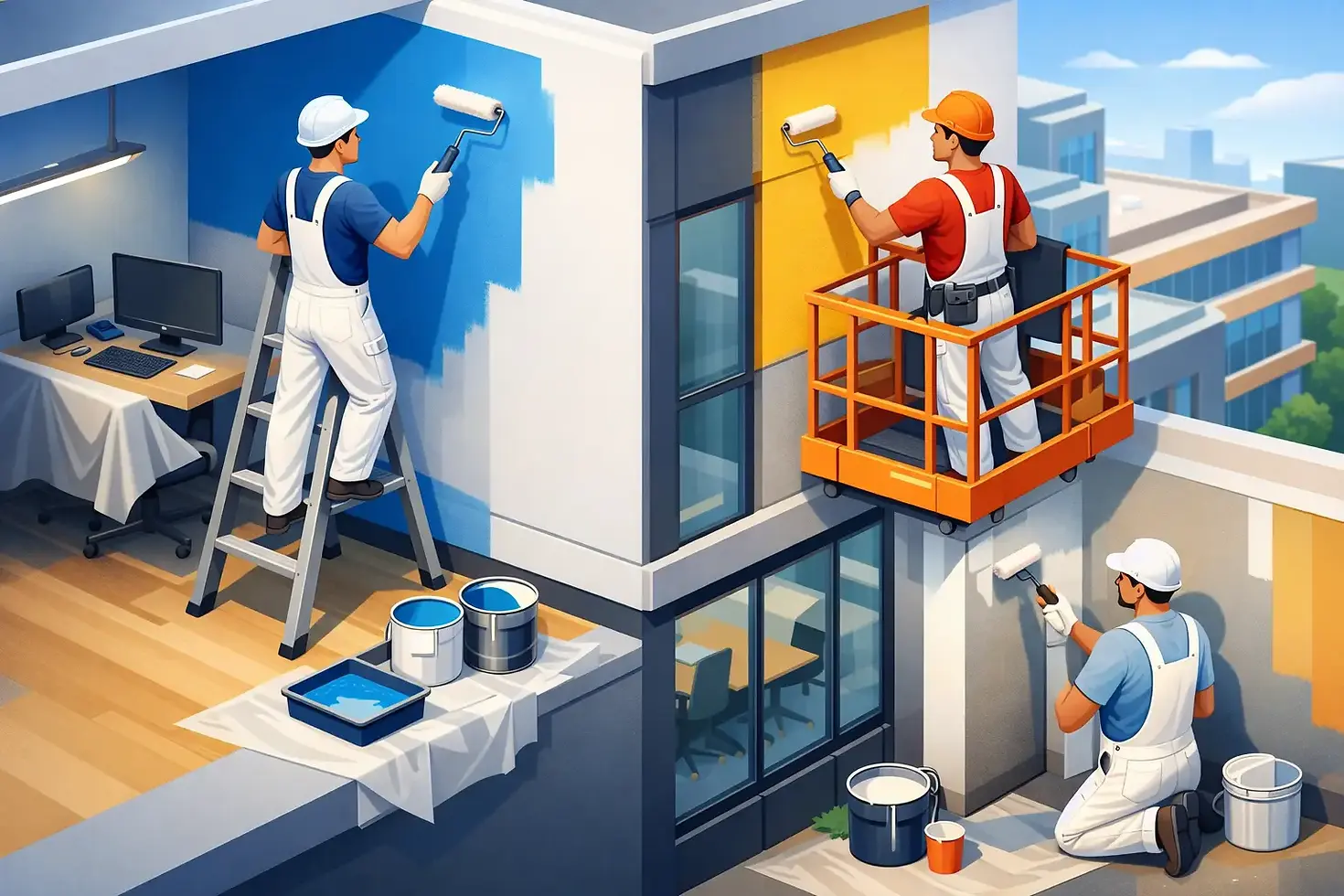
Commercial Painters Who Get the Job Done Right

When a commercial space needs painting, the finish is only part of the job. Owners, managers and tenants also need the work handled with care, clear communication and as little disruption to day-to-day operations as possible. That is where experienced commercial painters make a real difference.
A good commercial paint job should improve presentation, protect the building and hold up under daily wear. It should also be properly planned from the start. On shops, offices, strata properties, hospitality venues and industrial sites, there is usually more at stake than appearance alone. Timelines matter. Access matters. Safety matters. The condition of the existing surfaces matters.
What commercial painters actually manage
Commercial painting is rarely just a matter of turning up and applying paint. The work often starts well before the first coat goes on. Surface preparation, repairs, scheduling around staff or customers, and selecting products suited to the environment all shape the result.
That is why experienced commercial painters look at the full scope of the job, not just the square metres. A reception area with constant foot traffic needs a different approach from a warehouse wall. An exterior exposed to coastal conditions on the Tweed Coast needs different product choices from an internal office fit-out. The painting system has to suit the site, the use of the space and the condition of the substrate.
The quality of preparation is often what separates a finish that lasts from one that starts showing wear too soon. Cracks, flaking paint, water damage, surface movement and patch repairs all need to be dealt with properly. If they are painted over without attention, the final result may look acceptable for a short period, but it will not perform the way it should.
Why commercial painting needs a professional approach
In a home, delays are frustrating. In a business, they can affect trade, staff productivity and customer experience. Commercial work calls for a level of organisation that goes beyond basic painting skills.
The right contractor will think through access, staging and sequencing before work starts. That may mean completing sections in stages, working after hours, or planning around deliveries, tenants or public access points. On some projects, speed is important. On others, maintaining normal operations safely is the bigger priority. Often it is a balance of both.
There is also the question of durability. Commercial properties usually see heavier use than residential spaces, so product selection matters. Low-traffic decorative finishes may suit one area, while high-contact walls, external facades or wash-down zones need tougher systems. Choosing the wrong finish can create more maintenance and cost in the long run.
Professional commercial painters understand those trade-offs. The cheapest option on day one is not always the best value over five years. A more durable coating system can reduce repainting frequency, keep the property looking sharper and better protect the underlying surfaces.
Choosing commercial painters for your property
Not every painting contractor is set up for commercial work. Some are strong on smaller residential jobs but less experienced when a project involves multiple stakeholders, broader site coordination or more demanding timelines.
When comparing commercial painters, it helps to look beyond price. Ask how they approach preparation, what products they recommend for your building, how they manage disruption and what kind of finish you can realistically expect. A professional answer should be clear and practical, not vague.
Experience across different property types is also valuable. Offices, retail spaces, body corporate properties, medical rooms, schools and industrial facilities each come with their own demands. The more varied the project history, the more likely the contractor is to spot issues early and adjust the plan before they become bigger problems.
Communication is another major factor. Commercial clients usually need confidence that the job will be managed properly from quote through to completion. That means realistic timelines, tidy work practices and updates that keep everyone informed. Reliability on a commercial site is not a bonus. It is part of the service.
Commercial painters and the value of preparation
If there is one part of the process that should never be rushed, it is preparation. Good painting starts with getting the surface ready to accept the coating properly.
That can include washing down surfaces, removing failed coatings, sanding, patching, gap filling, treating minor damage and priming where required. In older buildings, preparation can be more involved because surfaces may have been repainted several times or exposed to years of weathering. In newer spaces, the issue may be getting a clean, uniform finish across recently repaired or altered areas.
Preparation is not the most visible part of the work, but it has a major impact on the result. Clean lines, even coverage and long-term adhesion all rely on what happens before the topcoats are applied. For commercial properties, where appearance reflects on the business itself, that attention to detail matters.
Interior and exterior work are not the same job
Commercial interiors and exteriors may sit under the same project heading, but they need different planning and product choices.
Inside, the priority is often presentation, wear resistance and minimal interruption to staff, customers or tenants. Odour, drying times and access all need consideration. In some settings, low-sheen washable finishes are the right fit. In others, durability and easy cleaning come first.
Outside, the building has to stand up to weather, sun exposure, moisture and general environmental wear. On the Tweed Coast, coastal conditions can be particularly hard on exterior finishes. Salt in the air, heat and strong UV exposure all place extra pressure on coatings. That means exterior work needs careful preparation and products chosen for local conditions, not just appearance.
A contractor who understands both environments can recommend a system that suits each area properly rather than applying a one-size-fits-all approach.
Minimising disruption during commercial painting
For many businesses, the best painting job is one that improves the space without creating unnecessary downtime. That does not always mean the fastest possible application. It means the work is organised in a way that supports the site.
Sometimes that involves staged works so one area remains operational while another is completed. Sometimes it means after-hours scheduling or weekend work. In tenanted or public-facing properties, it may also mean extra care around cleanliness, signage and site safety.
This is where workmanship and project management come together. A neat finish is expected, but so is a professional process. Floors and fixtures should be protected. Access paths should be respected. The site should be left orderly at the end of each stage. These details shape the overall experience just as much as the final paint finish.
The long-term value of a quality finish
Painting is often viewed as a cosmetic upgrade, but on commercial properties it also plays a protective role. A quality coating system helps shield surfaces from moisture, wear and environmental damage. Over time, that can reduce maintenance pressure and help preserve the presentation of the asset.
It also affects perception. A well-maintained building gives staff, clients and visitors confidence in the business operating within it. Faded, peeling or poorly finished paint sends the opposite message. For retail spaces and customer-facing premises in particular, presentation has a direct effect on how the property is experienced.
That does not mean every project needs the highest-cost specification available. It means the finish should match the purpose of the building and the expectations for longevity. In some cases, a refresh is enough. In others, more extensive preparation and a stronger coating system are the smarter investment.
What to expect from a reliable commercial painting contractor
A dependable contractor should be able to assess the site, explain the scope clearly and provide a practical recommendation based on the property rather than a generic package. That includes identifying repairs, discussing finish options and setting out how the work will be completed.
At Cre8tive Painting Services, that approach is built around precision, preparation and quality workmanship. Commercial clients want confidence that the work will be done properly, with attention to detail and respect for the property. That is exactly what a professional service should provide.
The best outcomes usually come from clear expectations on both sides. If there are access limitations, business hours to work around or specific presentation standards to meet, those should be discussed early. A good contractor will welcome that conversation because it leads to a smoother project and a better finish.
If you are planning works on a shop, office, strata property or other commercial site, look for painters who treat the job as more than a basic repaint. A quality result comes from preparation, sound product knowledge and a steady, professional process from start to finish. When that is handled well, the building not only looks better - it performs better too.


Comments